When I lived in the Washington, D.C. area I became the librarian and curator of the national Masonic memorial to George Washington known as “the face of American Freemasonry.” I was made a Mason in a room at the memorial and raised a third degree Freemason in a courtesy degree by George Washington’s own lodge in Alexandria.
I was an officer of an honourable Mystery School lodge in the District of Columbia and I became a 32nd degree Freemason in Alexandria. It was my privilege to be mentored in library science at the first ever library open to the public in the District, at the temple of the Supreme Council, 33°.
Freemasonry is the oldest and largest secular fraternity in the world. Its members must meet the criteria of being adult, male, of good character, and a believer in any form of a Supreme Being. In principle, the Craft stands for faith, charity, morality and knowledge, as well as liberty, equality and fraternity. George Washington was the first of fourteen presidents of the United States to become a Freemason.
The Memorial is the only physical national institution of Craft Freemasonry in the United States. At the annual Masonic Week conference there is a gathering at the Memorial of all the Grand Masters of the United States and their entourages, as well as some foreign Grand Officers.
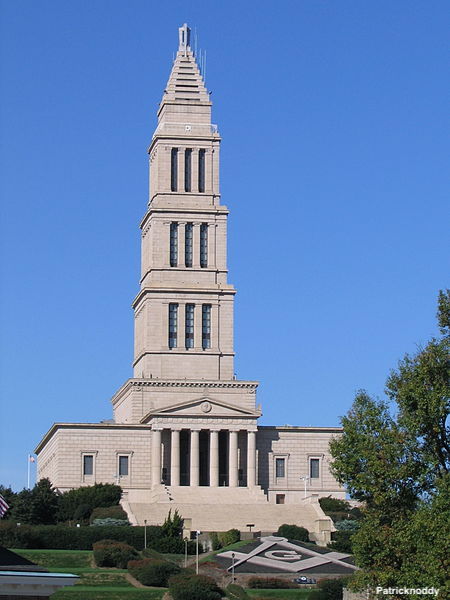
I was appointed initially as head librarian of the Memorial. I helped innovate the gift shop and helped staff the Memorial. As librarian of the Washington Library at the Memorial, I managed several collections of books and periodicals, including the Lemert collection.
R. J. Lemert, of Montana, was called the “Albert Pike of the Midwest” because of the extent of his esoteric knowledge. His writings appear in The Builder Magazine of the National Masonic Society in the early twentieth century alongside those of Roscoe Pound and Joseph Fort Newton.
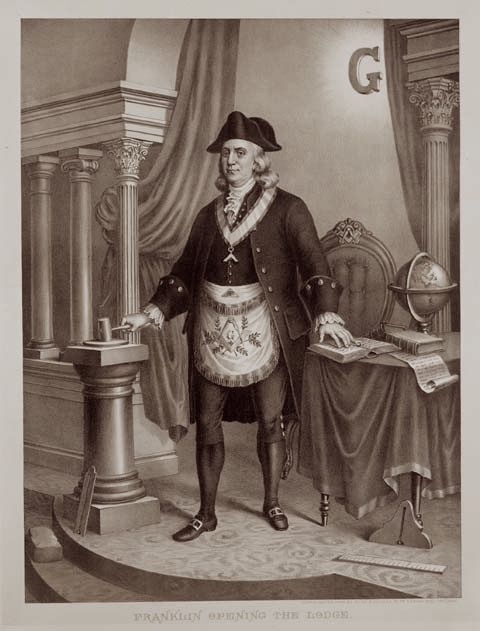
Lemert’s occult library included many rare volumes, including a first edition Eliphas Levi magical grimoire. I also managed the complete existing Masonic records of all American Freemasons, past and present. The library held Benjamin Franklin’s Constitutions of the Free-Masons, the first Masonic Book printed in America. This manuscript was a reprint of Anderson’s Constitutions of 1723, done in Philadelphia in 1734 specifically for Americans.
For the benefit of the Washington Library on the sixth floor of the Memorial I was allowed a world class mentor, a European teacher of library and information science, and expert in Masonic libraries. It was my honor to study under this librarian at the House of the Temple library, the collection founded by the father of Scottish Rite Freemasonry, Albert Pike, in 1891, and the first public library in Washington, D. C.
I also enjoyed taking visitors to the ninth floor observation deck, which overlooked the Potomac river, Old Town Alexandria, the dome of the Capitol Building and the Washington Monument. The latter is the only structure in the Washington DC area taller than the Memorial.
I had a view of Old Town Alexandria, where George Washington had his office, as well as the Potomac River and Washington DC. I sometimes paused to gaze at the Capitol dome and the Washington Monument from my library windows. It did not occur to me then that this was physically the highest office in the Washington D.C. area.
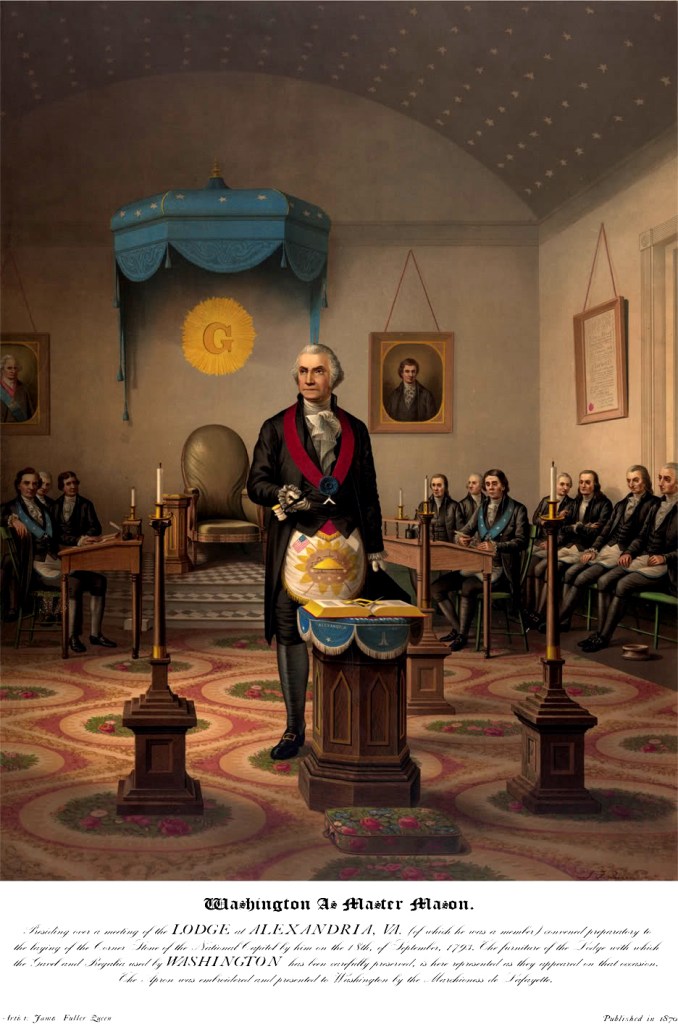
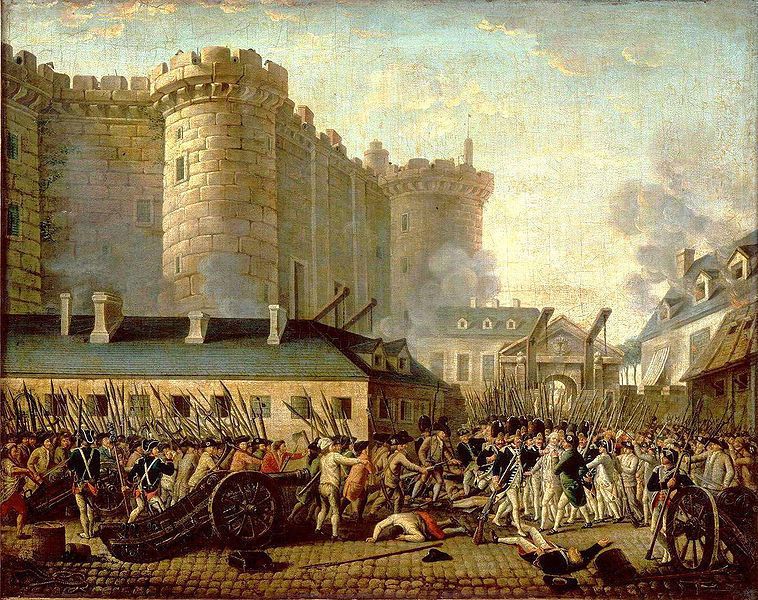
The museum, being always located in George Washington’s hometown adjacent to his home at Mount Vernon, preserves American Masonic artifacts and Washington artifacts. Under my care was one of the keys to the Bastille that General Lafayette brought to America directly after the storming of the Bastille during the French Revolution. He gave them as gifts to friends, in this case, members of George Washington’s Masonic Lodge in Alexandria.
We had the Washington family Bible signed by George, himself. I also curated his field trunk, tea set, and writing desk, all of which he carried on the battlefield, the two swords that covered his coffin in state, and even several strands of his hair. On the speculation about the use of genetic material taken from this hair to create an army of George Washington clones I will not comment.
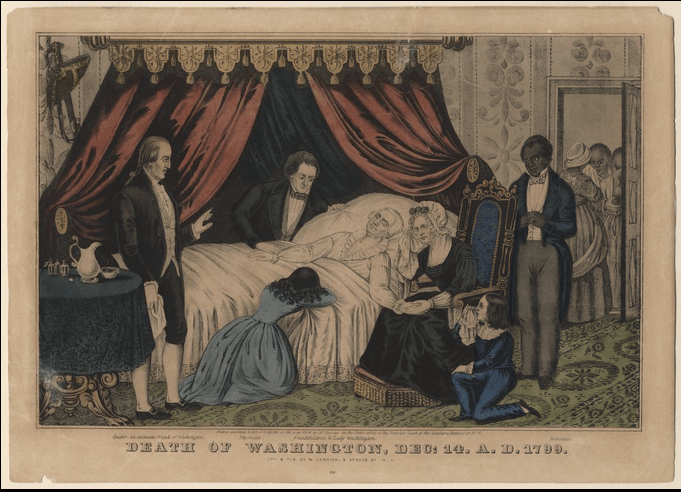
Perhaps my greatest contribution to the museum was to accept as a gift, on behalf of the museum and the Freemasons of America, the watch that timed Washington’s pulse at his death. Its owner was Dr. Elisha Cullen Dick, George Washington’s closest friend and second Master of his lodge in Alexandria.
Several respected curators in the District independently confirmed the provenance of the pocket watch. This watch was considered to be the most valuable acquisition since the Washington Bible.
I gave tours of the Memorial to groups of visitors as large as fifty and to every kind of visitor from school children to a U.S. Supreme Court Justice surrounded by security. The Memorial was known as “the face of American Freemasonry.” I liked to bring visitors to the Past Master’s Gallery in the foyer leading to the Alexandria-Washington lodge, a small enclave filled with portraits of every Worshipful Master of Alexandria-Washington Lodge, from George Washington to the most recent Past Master.
Just before I was hired as librarian, the author Dan Brown had used the Memorial library for research on his book –later made into a blockbuster film- The Da Vinci Code. I was given an inscribed first edition of this book by my dear friend Al Boswell, Past Master of Federal Lodge No. 1 in the District of Columbia, and at the time Executive Director of the Scottish Rite. May he rest in peace.
Dan Brown’s third book in the trilogy, The Lost Symbol, revolved around the Freemasons of Washington, D.C. The Memorial provided a location for a few scenes of the blockbuster film Angels and Demons, the sequel to The Da Vinci Code, and the Memorial featured in the blockbuster film, National Treasure, Book of Secrets.
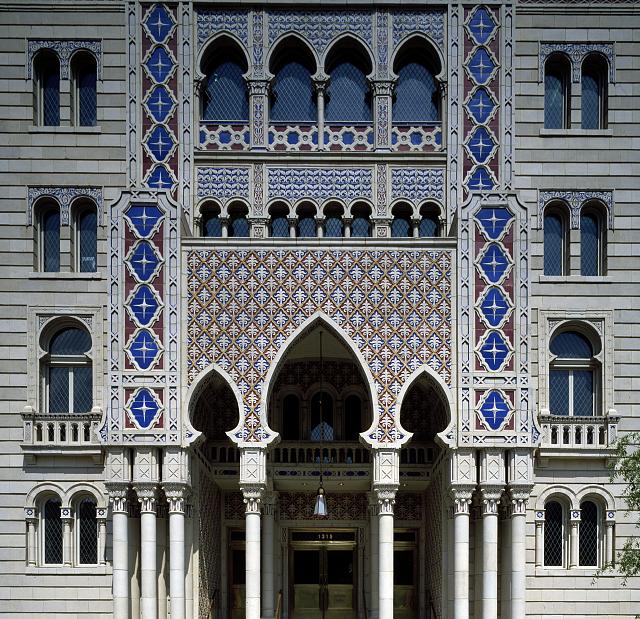
I was mentored on the three Blue Lodge Masonic degrees at various locations, including the Shriner’s Almas Temple on K Street, Washington, D. C., a Masonic building built in the Moorish architectural style in 1929. In order to pass to the Third Degree of Freemasonry I would have to be tested before the brethren of the District of Columbia.
When my mentor was satisfied with my proficiency in the Craft, I was examined before our lodge and the Grandmaster of the District of Columbia with his entourage of Grand Lodge officers. After I had passed the requisite trials in the midst of this assembly I offered a presentation on aspects of the history and philosophy of esoteric Freemasonry.
After this successful talk I was tasked with a paper on the Western Mystery Tradition. It was a challenge I completed even after I had left the fraternity to live in Indonesia, a country where Freemasonry is banned.
My “Mother Lodge,” the Lodge of the Nine Muses in the District of Columbia, was named for the famous lodge in Paris that promoted the Enlightenment and claimed such members as Benjamin Franklin and Voltaire. It was created in the early 1990s as a “Mystery School” by Past Masters of the Alexandria-Washington (A-W) Lodge No. 22.
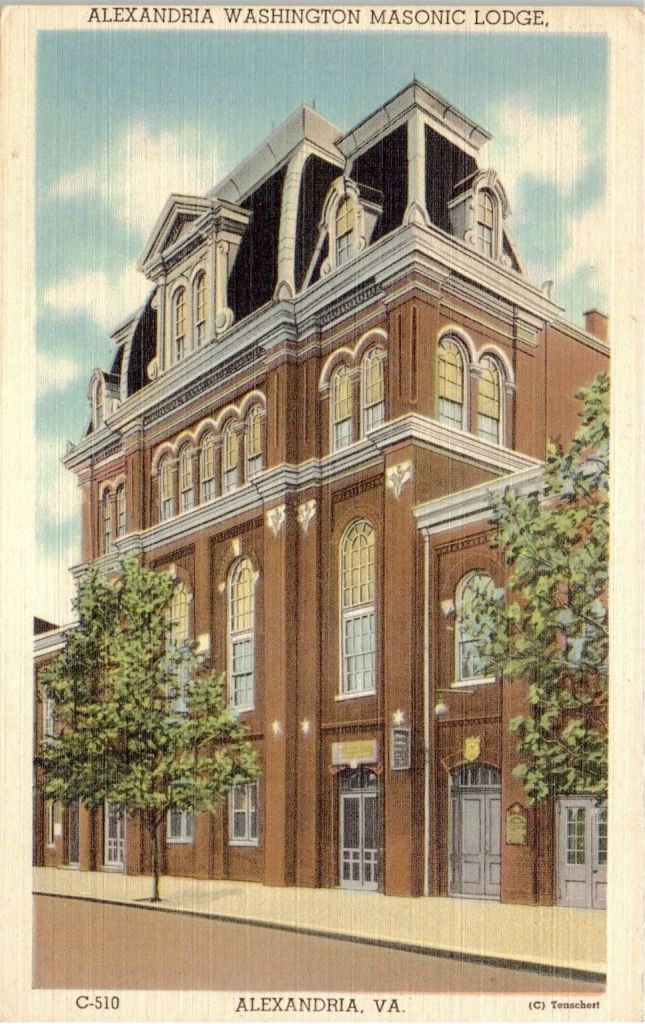
A-W Lodge No. 22 was located for the last fifty years at the Memorial. It was named for its founding Master, George Washington, after his decease. The lodge was relocated from the Alexandria Town Hall, which had suffered a great loss of George Washington personal items and memorabilia during a fire in the 1870s.
As I curated some of the remaining artifacts at the national Masonic Memorial to George Washington, the A-W lodge did me the honor of joining my lodge to raise me to the third degree of Freemasonry, Master Mason, in their lodge room at the Memorial.
My “Mother Lodge” was founded as the American equivalent of an esoteric lodge in England, the Lodge of Living Stones, from whence my mentor had emerged as a Past Master to become the founding Master of the Lodge of the Nine Muses No. 1776.
The founding Master of the English lodge in 1927 was Walter Leslie Wilmshurst (1867-1939), the author of several books on mysticism and esoteric Freemasonry, setting the example for my mentor.
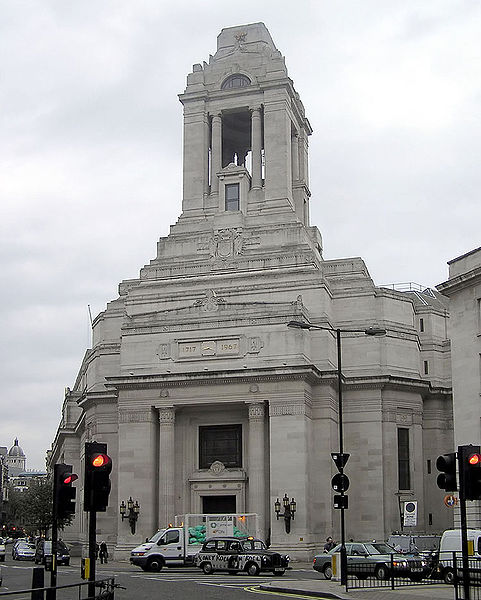
At one point in my two year apprenticeship I met my mentor in London and we went to Freemason’s Hall on Great Queen Street, the headquarters of the United Grand Lodge of England, the premier grand lodge of Freemasonry.
Masonic meetings have been held on the site since 1775, the current building being opened in 1933. The most ancient lodges in London still meet in the temple, including three of the four lodges that met before the Grand Lodge was formed in 1717.
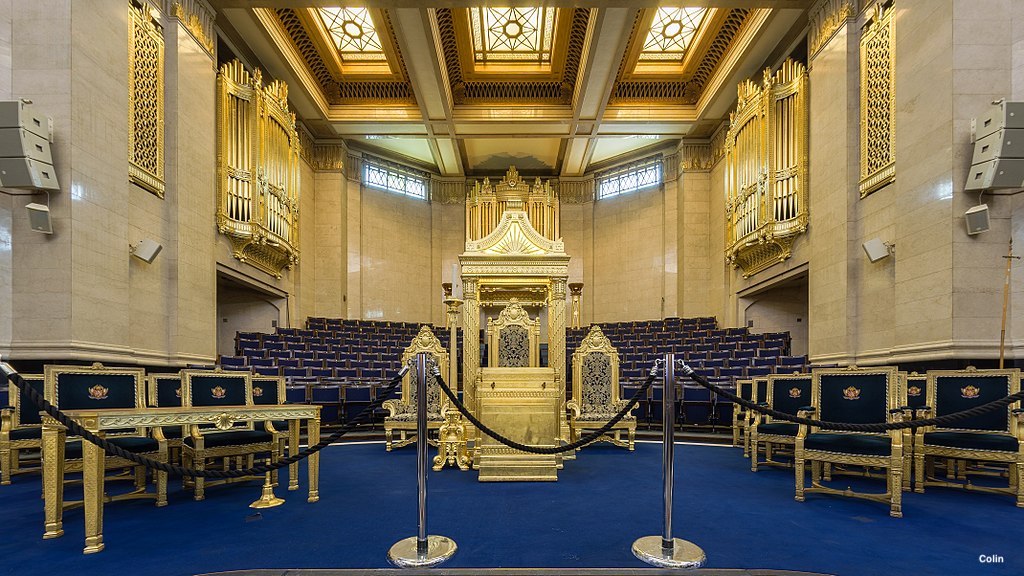
My mentor and I later took a bus to Leeds. We shared an inn with a group of Afro-American brethren, also guests of my mentor, the Worshipful Master of whom shortly thereafter became the first African-American Grandmaster of the District of Columbia. In a grand old gothic style building a group of eclectic Freemasons jovially welcomed us to their time-weathered lodge.
There I received the special attention of a researcher of Masonic symbolism and popular author who, it was claimed, was the inspiration for the popular novel The Da Vinci Code. Our discussion on the symbolism of the Masonic lodge was certainly interesting. The temple there was the epitome of old English charm, like a hidden chamber in a luxurious ancient castle, but unfortunately I have no images of it, and neither has the internet.
I spent a year in Chinatown, Philadelphia, before returning to Old Town Alexandria to write a history of the George Washington (National) Masonic Memorial.
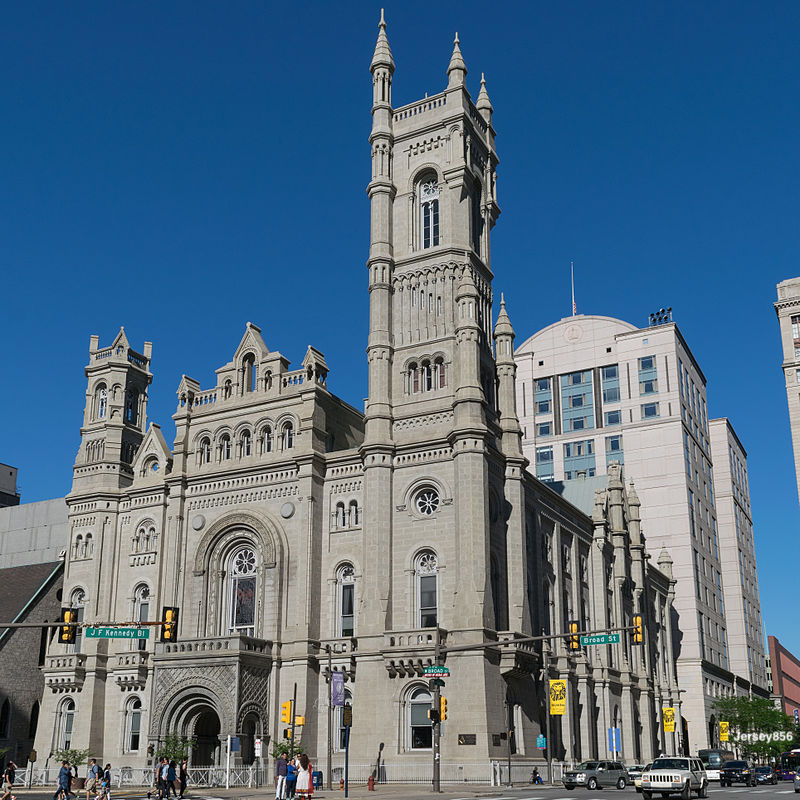
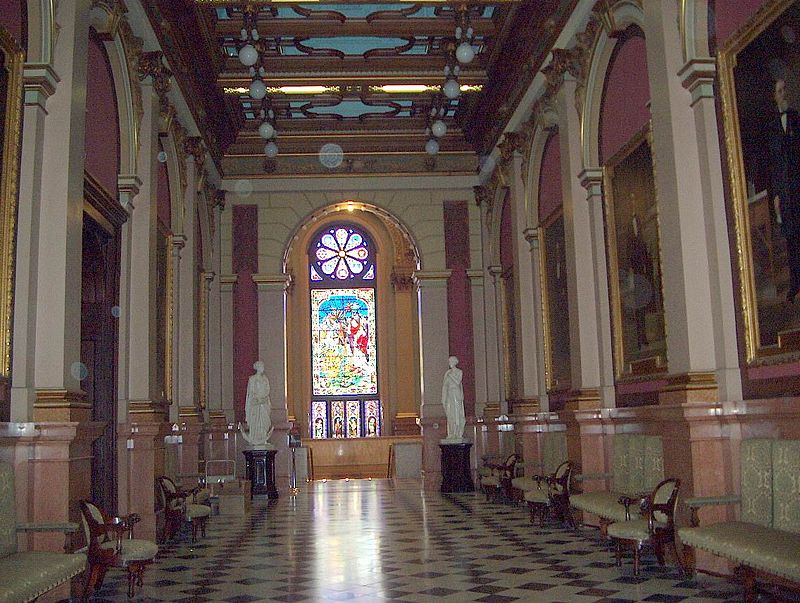
Freemasonry came to America from England through Boston and Philadelphia as early as 1715. The headquarters of the Grand Lodge of Pennsylvania in Philadelphia sits adjacent to City Hall. The building, completed in 1887, is one of the most beautiful and elaborate Masonic structures in the world. Independence Hall is just a short stroll away.
Pennsylvania was among the first colonies included in the provincial grand lodges created by the Grand Lodge of England. Benjamin Franklin served as Provincial Grand Master of Pennsylvania in the 1730s. I had the honor of meeting with the librarian at the temple. Speaking with her made me acutely aware of the essential role of this city and its Freemasons in the history of the United States of America.
New York was another colony included among the early provincial grand lodges. The first Freemasons in New York were active by the 1730s. The Grand Lodge of New York was founded in 1782. The oldest operating lodge in New York, St. John’s Lodge No. 1 in Manhattan, keeps the George Washington Inaugural Bible upon which George Washington took his oath of office to become the first President of the United States in 1789.
The Masonic Hall in Manhattan is the headquarters of the Grand Lodge of New York. I do not have pictures from my visit but there is a photo gallery from the old Grand Lodge website in the Wayback Machine archives for those who are curious.
One of the highlights of my Masonic experience was to act as candidate for the thirty-second degree of the Scottish Rite in the company of good men. There were lawyers, doctors, scientists, business men, government men, policemen, firemen and craftsmen. This was not like the private club scene along the East Coast United States or in London, England. This was a cross section of the entire male community of Alexandria, Virginia.
The Scottish Rite leans heavily on comparative religion and speculative alchemy. It accepts only Third degree Freemasons and offers degrees up to the 32nd degree, conferring a 33rd on those who have made an exceptional impact on Freemasonry or society at large.
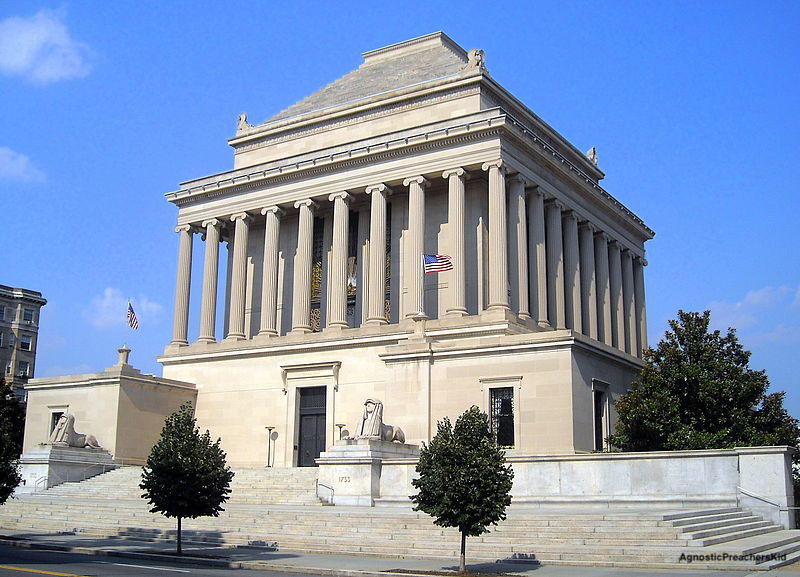
Divided into Northern and Southern jurisdictions, the headquarters of the Supreme Council, Southern jurisdiction, is the House of the Temple in Washington, D.C. The Supreme Council was founded in 1801. 110 years later construction began on the House of the Temple and it was dedicated in 1915.
Following the example of my uncle, my wife and I joined the Order of the Eastern Star (OES) in the District of Columbia, and visited their lovely mansion downtown. King Edward VIII of the United Kingdom was a guest in 1919 and was at that time introduced to Wallis Simpson. The OES, founded in the nineteenth century, is the branch of “regular” or Anglo-Freemasonry that allows Freemasons and women relatives of Freemasons to join in ritual.
The OES is comparable with “irregular” or “clandestine” co-masonry, or Egyptian Masonry, a subject of interest to the director of the museum of the Grand Lodge of Scotland, who produced an excellent tome on the magician Cagliostro, the founder of the Egyptian Rite. My wife and I were impressed with the lovely mansion that belongs to the OES, the Belmont Mansion, also known as the General Grand Chapter headquarters, or the International Temple.
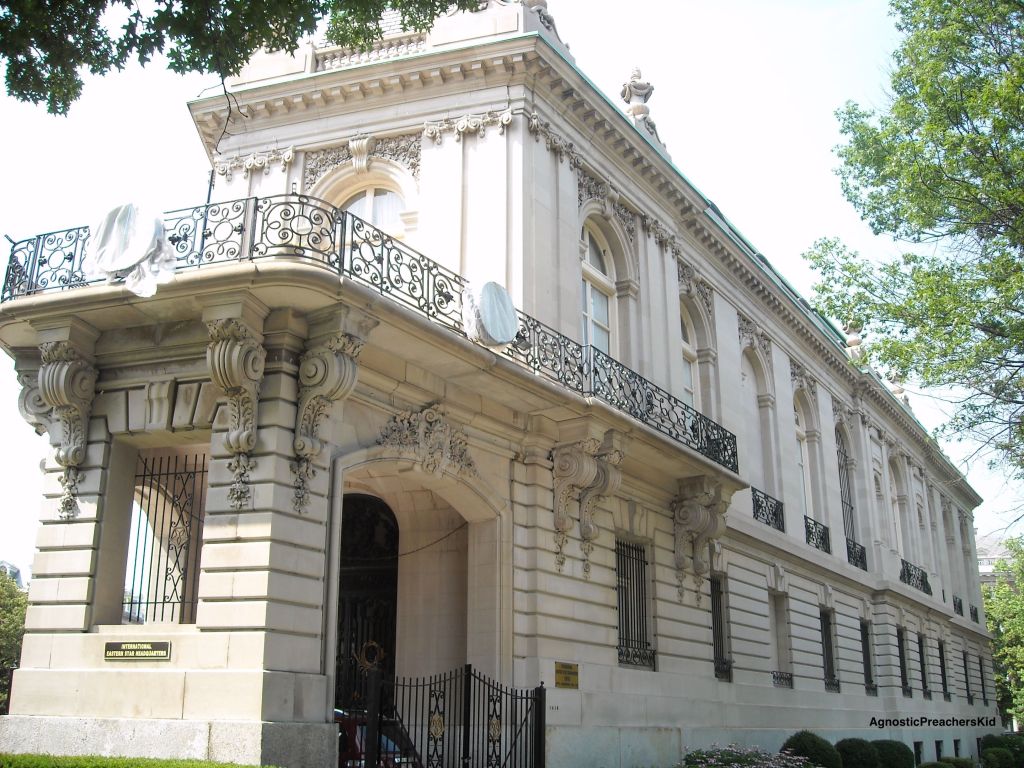
At the time I was also in an off-the-books discussion with the “unrecognized” freethinking environmentalist- equally ancient and legitimate- Grand Orient of France. With the Grand Master of the Grand Orient in the United States we discussed the founding the first Grand Orient lodge in Washington DC. I was too busy to accept the offer of becoming the first Master of that lodge.
Things are about to get esoteric here, so if you are not into that, you may want to skip this section and cruise right over to the next post: Chinese temples!
I was the Junior Warden, the third ranked officer of the small, esoteric lodge, when I left the fraternity. I was expected to become the next Senior Warden and then Master of the lodge within the next few years. Along with Masonic tradition I was also being taught Kabbalah, the Jewish mystical system, which derived from Jewish Gnosticism and neoplatonism. Like neoplatonism, the design of the Kabbalistic method follows the mystical ascent, with God as the Emanator of the four stages or planes of Creation.
According to Kabbalah, man is born in the lowest plane, the physical, and is to reverse his sinful nature to return up the vertically aligned worlds to the Godhead. Upon the four worlds hang the ten Sephirot, or Crowns, the attributes of God (derived from I Chronicles 29:11). The Sephirot, collectively called the Tree of Life, are landmarks to guide man in his Mystical Ascent.
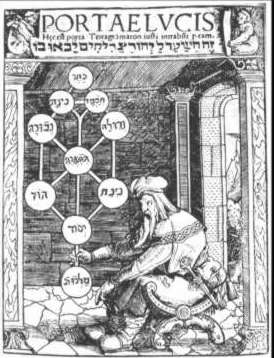
The Kabbalist acts to unify the Sephirot through prayer and meditation on the Tree of Life. The mystical ascent is described by the process of Tikkun, which means restoration or return, the quest for the everlasting communion between all creatures and God, the object of humankind. This cosmology is simply a technical description of the fall of Man from the Grace of God, and the method of acting toward the restoration of that Grace.
According to legend the Kabbalah was given by God to Adam, and was known by Abraham, Moses, and Solomon. Actually, the mystical tradition had its roots with the Jews who relocated to Alexandria, Egypt after the destruction of the Second Temple of Jerusalem around 70 CE. Esoteric Judaism developed with Hellenist, syncretistic or magical, and perhaps Persian influence during this first century of the Common Era.
The tradition took shape in the second century Sepher Yetzirah, the “Book of Creation.” Kabbalah crystallized into a mystical system in the twelfth century in Southern France and Spain, especially in the Book Bahir. It became popularized with the rabbinical literature of the Zohar, the “Book of Splendor,” written in thirteenth century Spain by Moses de Leon.
Christian Kabbalism began to flourish in the fifteenth century, when Cosimo de Medici offered his patronage to the Platonic Academy in Florence centered on Marsilio Ficino (b.1433, d.1499). Ficino was the translator of the Hymns of Orpheus, the Hymns of Zoroaster, the Corpus Hermeticum, and a number of the early neoplatonic philosophers. He was also profoundly influenced by alchemical and magical texts.
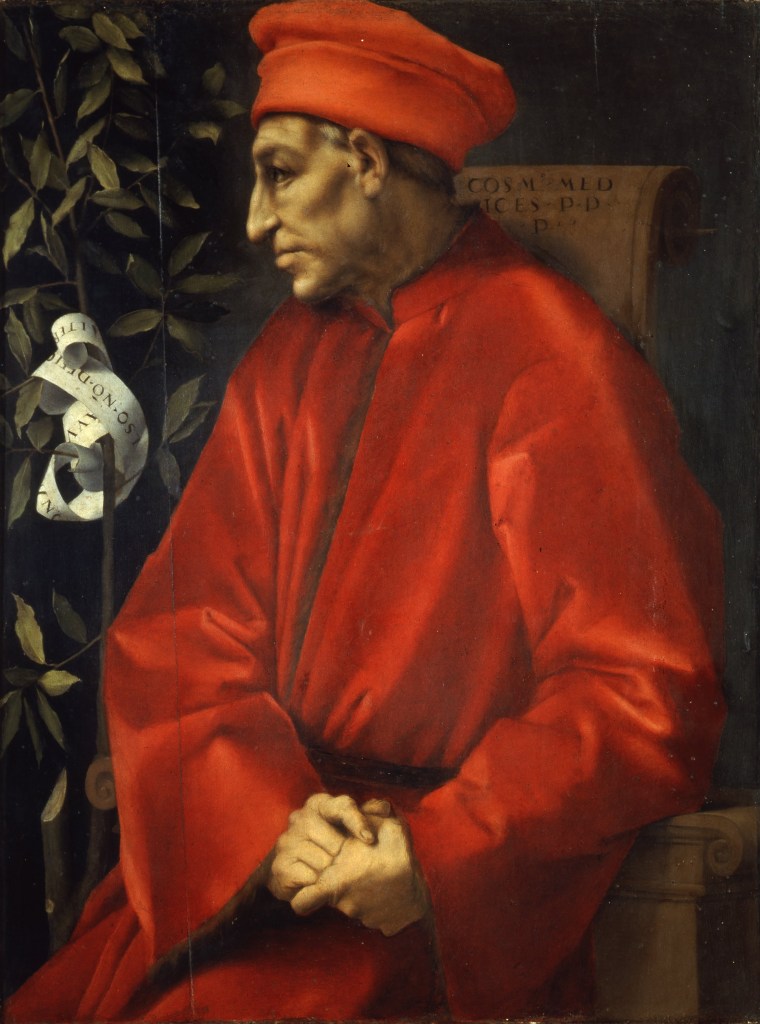
One member of Ficino’s circle was Giovanni Pico della Mirandola (b.1463, d.1494), who had Kabbalistic literature translated for him by a Jewish convert, and published his syncretistic 900 Thesis that grew to fame. Pico was the first to assert that Kabbalah and magic were the best means to prove the divinity of Jesus Christ. This Hermetic-Kabbalistic tradition influenced the Renaissance and early Freemasonry.
My mentor’s Kabbalah teacher was Warren Kenton, also known as Z’ev ben Shimon Halevi, a teacher in the Toledano line of Kabbalah. Kenton is a well-known author and speaker. He was a founding member of the Kabbalah Society and Charles, Prince of Wales, is one of his Kabbalah students, speaking highly of his methods.
My lodge was the smallest in the District, founded by Past Masters of George Washington’s own lodge in Alexandria, and a Western Mystery Tradition school. Four of us were from Iowa, the eldest being a 7 = 4 of the Hermetic Order of the Golden Dawn and a ninth degree member of the O.T.O. I visited the Maryland branch of the O.T.O. during this period, enjoyed conversations with the world’s foremost historian of the Hermetic Order of the Golden Dawn, and cultivated my acquaintance with the primary historian of the A.’.A.’.
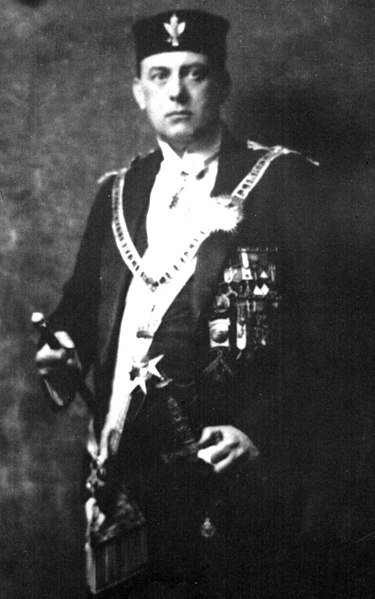
These hermetic orders are based on an esoteric Christian movement known as Rosicrucianism. The Rosicrucian Movement, based on a system of Christian alchemical mysticism, embodied many aspects of the Renaissance Hermetic-Kabbalistic tradition.
The order began as a myth in the early seventeenth century, originally published in Germany in two anonymous manifestos, the Fama Fraternitatis Rosae Crucis and Confessio Fraternitatis. Written mid-seventeenth century, the manifestos specifically indicate that their mythical founder, Christian Rosenkrutz, studied “Magia and Cabala” (Fama Fraternitatis) and praise is given to Paracelsus, the famous sixteenth century alchemist.
The Rosicrucian philosophy and Art was based on medicine and healing, mathematics and mechanics, but the main goal of its Art was spiritual. The society, itself, was fictional, but many believed the manifestos’ claims of authenticity.
Learned alchemists appreciated the concept of the Invisible College developed in these manifestos and several Hermetic fraternities were formed in the heart of Christendom. The Art of Hermes is the theory and practice of speculative alchemy, producing wholesome elixir or medicine, in the alchemist’s allegorical laboratory.
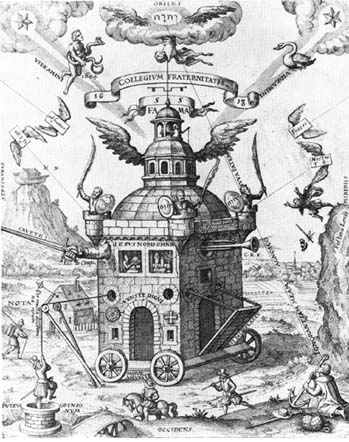
The Temple of the Rosie Cross travels on four wheels, and yet is tied to Heaven by a rope, symbolizing that it remains eternally tied to the divine while it may go anywhere on the earth. This house of the Holy Spirit is the invisible college of the Rosicrucians. It is found everywhere and nowhere, throughout all ages, but it only appears to those who meditate deeply and enter into wisdom.
Certain individuals are known to have had connections with both the Rosicrucian and the early Masonic communities, most prominently the alchemist Elias Ashmole, the second recorded Speculative Freemason in history. As early as 1638 Freemasonry was associated with the “brethren of the Rosie Crosse,” in a poem published in Edinburgh.
Evidence exists for a joint meeting between the two fraternities and a century later the Rose Cross grade was created for the Masonic degree system. The early Freemasons therefore certainly had access to the Rosicrucian mystical philosophy, which has been shown to be adaptable to Masonic purposes, when they formed their own deity-centered, liberal arts-oriented secret society.
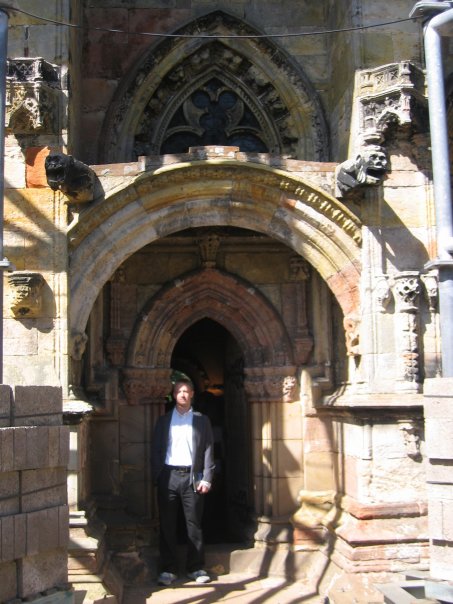
Author at Rosslyn Chapel, Midlothian, Scotland
The central theme of the ritual of Freemasonry is the building of King Solomon’s Temple in Jerusalem. Built about 1000 BCE, but not standing today, this temple figures heavily in Judeo-Christian history and mythology. It contained a space called the Holy of Holies, wherein sat the Ark of the Covenant and its contents, the two stone tablets of the Ten Commandments. Freemasons consider Solomon’s Temple the symbol of “the temple not made with hands.”
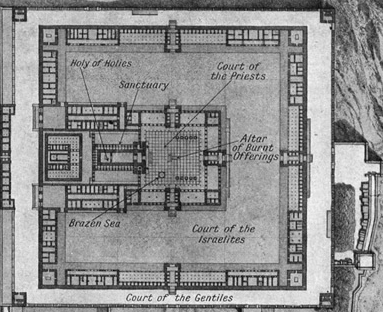
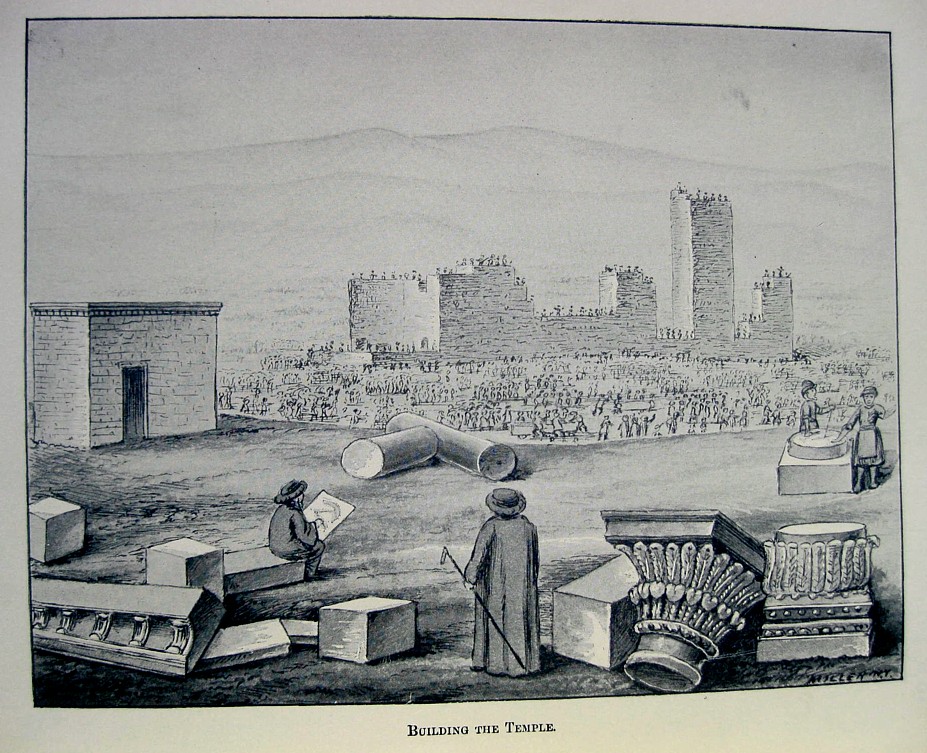
I personally chose not to assume the duties required of a Master of a Masonic lodge, and not to pursue membership in a hermetic society like the Golden Dawn, the O.T.O. or the A.’.A.’., although these are all worthy labours. It is as a traditional Blue or Craft Lodge Master Mason and thirty-second degree Scottish Rite Mason that I studied the structure and experienced the essence of the Western esoteric tradition. Noble as that may be, there is more to learn, so my meditation called me closer to the wisdom of the East.
Our next post takes us to the East.

 Temples Along the Way